
Search for a Replacement
The Vishay SI2323DDS-T1-GE3 is a P-channel, 20V MOSFET in a SOT-23 package. It has been a reliable specification for engineers across a wide range of low-power applications. But sourcing teams running availability checks today face a difficult picture.

SiliconExpert’s market availability view shows zero stock across major authorized distributors, with a 52-week factory lead time. For sourcing and engineering teams managing active production, that window represents serious continuity risk. The natural response is to search for alternatives.
We Asked Two Leading AI Models the Same Question
To understand how general-purpose AI tools address this scenario, we submitted the same prompt to both ChatGPT and Google Gemini:
“Why is part number SI2323DDS from Vishay difficult to find?”
Both models provided detailed responses explaining the supply constraints and then offered alternative component recommendations.
|
ChatGPT (left) |
Gemini (right) |
|
DMG3415U-7 — my first choice |
DMG3415U-7 (widely stocked alternative) |
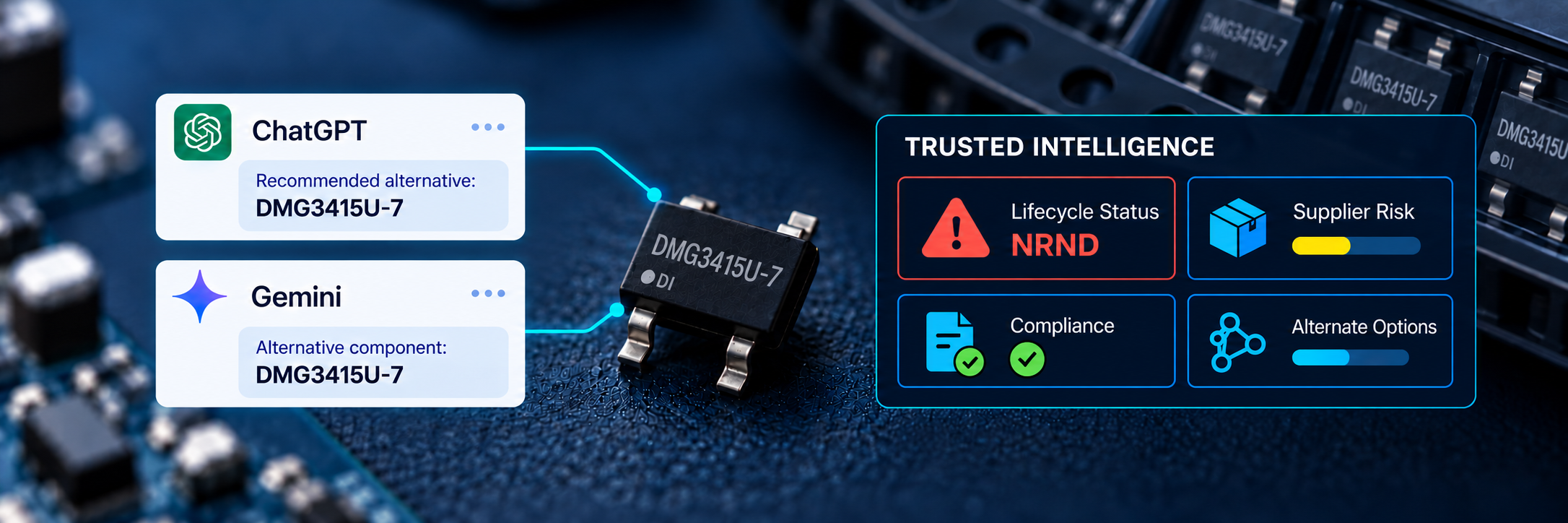
Both models independently recommended DMG3415U-7 as their top alternative.
Two AI systems, prompted independently, converged on the same answer. That level of agreement carries apparent credibility. It suggests the recommendation is well-founded, not coincidental. It looks like a signal.
At First Glance, the Recommendation Looks Good
ChatGPT shows DMG3415U-7 (Diodes Incorporated) as electrically close to the SI2323DDS-T1-GE3 in several important ways: P-channel, 20V VDS, SOT-23-3 package, ±8V VGS, and 39 mΩ max RDS(on) at 4.5V. Though the match was described as “almost eerily close.” Under scrutiny, however, it becomes clear that the apparent confidence is despite inaccuracies and flawed logic. While ChatGPT lists 39 mΩ max at 4.5V as a shared spec for both components, on SiliconExpert’s platform reveals validated manufacturer data that says otherwise, as seen below.

On the market availability side, the picture appeared considerably better than the original Vishay component.

With over 233,000 units available across distributors and a 32-week lead time, the recommendation appeared to solve the immediate sourcing problem. Parametric similarity checked. Availability checked. Both AI models agreed. Confidence looked justified.
The Missing Signal

When the DMG3415U-7 is evaluated in SiliconExpert, a critical data point surfaces immediately: the component carries a Not Recommended for New Design (NRND) designation with an estimated end-of-life date of 2027 and a lifecycle stage of Decline.
Both AI responses focused on parametric similarity and current availability signals. Lifecycle status was absent from the analysis entirely.
NRND does not mean a component is unavailable today. Current inventory can still be purchased and used for existing designs. However, NRND means the manufacturer has signaled this component’s time as a viable design-in option is ending. For any team evaluating this part as a long-term replacement, that distinction carries significant implications for redesign timelines, production continuity, and downstream cost.
A component can appear available today while introducing avoidable lifecycle risk tomorrow.
Independent Validation Confirms the Risk
The NRND finding from SiliconExpert is not based on proprietary judgment alone.

SiliconExpert links directly to source documentation from the supplier. Diodes Incorporated datasheet for the DMG3415U carries an explicit banner at the top of the document: NOT RECOMMENDED FOR NEW DESIGN — USE DMP2045U
This is the manufacturer’s own documentation. SiliconExpert’s lifecycle intelligence and the manufacturer’s published datasheet reach the same conclusion independently. The risk is real, and it is traceable to source.
This is the kind of evidence that supports an engineering or sourcing decision. It is also the kind of evidence that general-purpose AI tools, trained on broad web data without continuous manufacturer notification integration, are not positioned to surface reliably.
Looking Beyond Availability
The difference between what the AI tools provided and what SiliconExpert revealed reflects the difference between availability intelligence and lifecycle intelligence.
General-purpose AI identified parametric similarity and stocking information. SiliconExpert surfaced lifecycle status, resilience implications, manufacturer guidance, and future availability risk, all in a single view.

SiliconExpert’s Resilience Rating for the DMG3415U-7 presents this clearly: a lifecycle score of Poor, a weighted lifecycle attribute carrying 25% of the overall rating, and an estimated EOL date of 2027. The overall resilience score sits at 5.3 (Fair), driven downward significantly by the lifecycle dimension.
For teams managing multi-year production programs or protecting products through long design lifecycles, this data changes the decision entirely.
More Choice, Better Decisions
Rather than presenting a single replacement, SiliconExpert surfaces multiple validated alternatives with active lifecycle statuses.

The SiliconExpert Crosses view for the SI2323DDS-T1-GE3 returns 45 crosses, including several active, premium manufacturer options with comparable parametric profiles:
- DMP2037U-13 (Diodes Incorporated) — Active lifecycle, B/Upgrade cross, 17.9 YTEOL
- DMP2037U-7 (Diodes Incorporated) — Active lifecycle, B/Upgrade cross, 17.9 YTEOL
- MFT2P5A8S23SS (Meritek Electronics Corporation) — Active lifecycle, B/Upgrade cross, 11 YTEOL
Each of these alternatives carries an Active lifecycle designation, meaning engineers can design with confidence, knowing they can rely on long-term availability and manufacturer support. The rating of “B/Upgrade” signifies pin-to-pin compatibility with minor electrical and/or package dimension differences; “upgrade” indicating better performance than the original part.
Trusted intelligence amplifies AI-assisted decisions by adding validated context that drives better outcomes. The goal is to ensure those recommendations are evaluated against the lifecycle, compliance, and resilience data that engineering and sourcing decisions require.
Section 8: What Trusted Intelligence Adds to AI Workflows
When general-purpose AI accelerates research, the intelligence layer beneath the recommendation determines whether the outcome is a good decision or a fast mistake.
“In the age of agentic AI, organizations can no longer concern themselves only with AI systems saying the wrong thing; they must also contend with systems doing the wrong thing.”
– State of AI trust in 2026: Shifting to the agentic era
SiliconExpert’s Trusted Intelligence framework connects four capabilities that general-purpose AI did not replicate independently:
|
Capability |
What It Delivers |
|
Confidence |
Validated manufacturer data, traceable to authoritative sources |
|
Context |
Lifecycle and resilience insights that reveal risk beyond availability |
|
Choice |
Multiple active alternatives evaluated against technical and sourcing requirements |
|
Resilience |
Long-term sourcing risk visibility, including EOL forecasting and manufacturer notifications |
SiliconExpert combines authoritative sources, validation by design, continuous governance, and human domain expertise to ground AI in trusted electronics data, so teams can trace the evidence, understand the context, and act with confidence.
Conclusion
ChatGPT and Gemini both surfaced a technically plausible alternative for the SI2323DDS-T1-GE3. The recommendation was parametrically close, appeared widely available, and carried conviction through independent agreement between two models.
SiliconExpert revealed that the same recommended component carried an NRND designation, had entered a lifecycle stage of Decline, and was approaching manufacturer end-of-life in 2027, supplying the manufacturer’s own datasheet as source documentation.
Engineering and sourcing decisions reach their best outcomes when recommendations are grounded in validated lifecycle intelligence. Speed and pattern recognition are valuable. They become most valuable when connected to the data that tells the full story.
To learn more about how SiliconExpert advances proactive risk management, download the Data Validation Methodology whitepaper.
Before acting on an AI recommendation, validate the data behind it. Download our Trusted Intelligence whitepaper to explore how validated component data and domain expertise support more informed engineering and supply chain decisions.