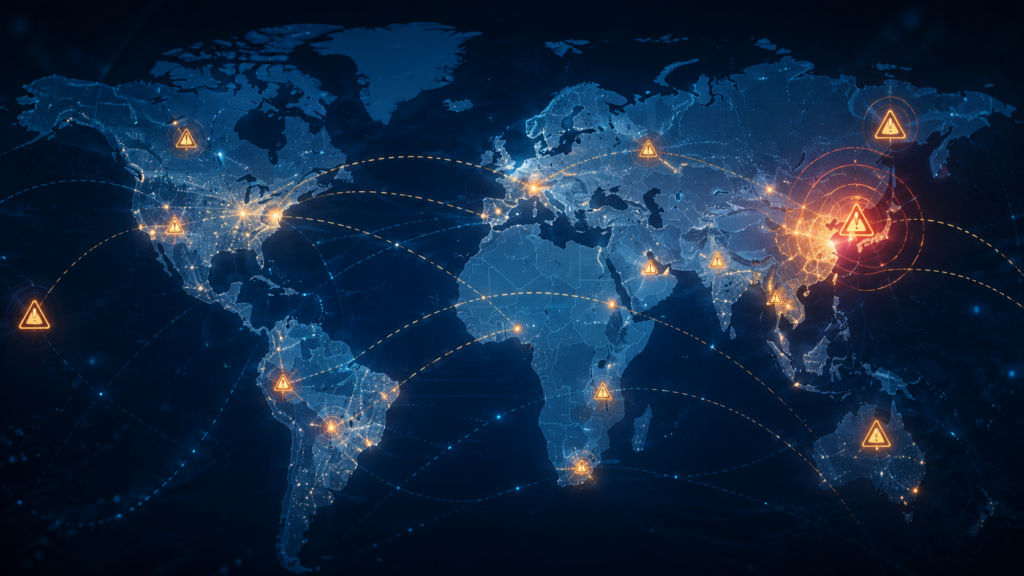


When a Global Event Becomes Your Problem in Minutes
It’s 6 a.m. on a Tuesday. A major earthquake has struck a region that produces semiconductors critical to your product line. Your phone is flooded with messages. Your team is asking questions that demand immediate answers: Which parts are affected? Which suppliers sit near the epicenter? How severe is the exposure?
The quality of your response in the next few hours depends entirely on the intelligence infrastructure your team built long before the earthquake. Leading supply chain teams evolve from reactive sourcing to proactive planning by identifying component risk signals early and understanding their impact on supply continuity, availability, and cost.
Teams with the right tools in place open that moment with a prioritized, data-backed action plan. Teams without them open it with a search for information that should already be in front of them.
Strategic agility is a capability built deliberately, in advance, from the right combination of data, tooling, and process.
The Intelligence Gap That Widens with Every Disruption
Electronics manufacturers typically have supply chain monitoring tools already deployed: ERP systems, distributor portals, supplier communications. Each of these tools serves a function. Together, they share a structural limitation: they surface information about what has already happened rather than what is actively unfolding or what is likely to come next.
Supply chain disruptions are predictable when early risk signals are connected to real sourcing and planning decisions. When those connections are absent, teams encounter a consistent set of consequences:
- Sudden component shortages and supplier allocation constraints that arrive without advance warning
- Limited visibility into sub-tier supplier risk that only becomes apparent after a disruption cascades
- Volatile lead times and pricing signals that arrive too late to inform sourcing decisions
- Time-pressured sourcing decisions made with incomplete market context
Each of these outcomes follows directly from an intelligence gap, and each compounds the cost and complexity of the response. 93% of manufacturing and supply chain leaders believe trade wars will likely escalate in the next few years, and 91% note that global tensions are actively being factored into their company’s long-term supply chain strategy. The operating environment rewards teams that close this gap before the next event, because the next event is a near certainty.
What Strategic Agility Requires
Strategic agility in electronics supply chain management means the time between event awareness and prioritized action is measured in hours. Achieving that speed requires three capabilities working together simultaneously.
Build a Faster Disruption Response Process
Global disruption alerts only create value when they are connected to your actual parts, suppliers, and BOMs. See how SiliconExpert helps supply chain teams identify exposure, prioritize affected components, and act before risk reaches production.
When a Global Event Becomes Your Problem in Minutes
It’s 6 a.m. on a Tuesday. A major earthquake has struck a region that produces semiconductors critical to your product line. Your phone is flooded with messages. Your team is asking questions that demand immediate answers: Which parts are affected? Which suppliers sit near the epicenter? How severe is the exposure?
The quality of your response in the next few hours depends entirely on the intelligence infrastructure your team built long before the earthquake. Leading supply chain teams evolve from reactive sourcing to proactive planning by identifying component risk signals early and understanding their impact on supply continuity, availability, and cost.
Teams with the right tools in place open that moment with a prioritized, data-backed action plan. Teams without them open it with a search for information that should already be in front of them.
Strategic agility is a capability built deliberately, in advance, from the right combination of data, tooling, and process.
The Intelligence Gap That Widens with Every Disruption
Electronics manufacturers typically have supply chain monitoring tools already deployed: ERP systems, distributor portals, supplier communications. Each of these tools serves a function. Together, they share a structural limitation: they surface information about what has already happened rather than what is actively unfolding or what is likely to come next.
Supply chain disruptions are predictable when early risk signals are connected to real sourcing and planning decisions. When those connections are absent, teams encounter a consistent set of consequences:
- Sudden component shortages and supplier allocation constraints that arrive without advance warning
- Limited visibility into sub-tier supplier risk that only becomes apparent after a disruption cascades
- Volatile lead times and pricing signals that arrive too late to inform sourcing decisions
- Time-pressured sourcing decisions made with incomplete market context
Each of these outcomes follows directly from an intelligence gap, and each compounds the cost and complexity of the response.
93% of manufacturing and supply chain leaders believe trade wars will likely escalate in the next few years, and 91% note that global tensions are actively being factored into their company’s long-term supply chain strategy.
The operating environment rewards teams that close this gap before the next event, because the next event is a near certainty.
What Strategic Agility Requires
Strategic agility in electronics supply chain management means the time between event awareness and prioritized action is measured in hours. Achieving that speed requires three capabilities working together simultaneously.
Build a faster disruption response process
See how SiliconExpert connects global event intelligence to your parts, suppliers, and BOMs so teams can prioritize action before risk reaches production.
Real-time event intelligence connected to your specific parts
Global event monitoring has broad availability. What creates strategic agility is event intelligence mapped directly to the parts, suppliers, and BOMs in your portfolio. A regional disruption alert means something specific to your team when it surfaces the exact components at risk, the severity of the potential impact, and the recommended response path.
Prioritization by impact
Teams use Disruption Rating and the Disruption Report to rank parts by severity of active events and focus on those most likely to impact availability, lead times, or pricing. Prioritization by impact directs team attention and resources toward the parts and suppliers that carry the greatest production risk, enabling faster escalation decisions and more efficient response execution.
How SiliconExpert Operationalizes Strategic Agility
A supply chain manager receives a real-time urgent event alert, delivered by AI-powered Urgent Event Notifications that use machine learning to continuously monitor global developments, automatically evaluate each event against the customer’s supply chain, and prioritize alerts by production impact. When an event such as an earthquake near a semiconductor fab surfaces, the team uses the Events Browser, Disruption Rating, and GeoRisk for sub-tier visibility to quickly assess severity and decide whether to escalate internally.
Leadership reviews the Intelligence Recommended Actions table and Summary Report to view supply chain issues across their critical parts list and monitor issues via the Action Center. SiliconExpert connects the dots across the supply network, delivering early warnings and anticipating real business impact, revealing ideal response strategies, surfacing alternative sourcing options, and unlocking agility while enabling increased productivity.
Supply chain professionals need actionable intelligence that links risk to real parts, suppliers, and production lines. SiliconExpert provides solutions that support proactively building resilient products while also developing strategic disruption response plans, so teams can act with data-backed confidence in any situation.
The result is a team that enters every disruption, geopolitical, environmental, or operational, with the situation already assessed, the affected parts already identified, and the response path already visible.
The Compounding Value of Acting Early
Speed in disruption response generates a compounding advantage. Teams that act in the first hours of an event secure sourcing options, lock in pricing, and adjust inventory positions before the broader market responds. Every hour of lead time translates into measurable cost avoidance and production continuity.
Strategic agility means getting real-time alerts of critical events and taking swift action with prioritized visibility into global supply chain threats.6 That visibility, built on verified data, mapped to your actual portfolio, and surfaced at the moment of relevance, converts disruption events from crises into manageable inflection points.
The manufacturers who respond fastest are the ones who built that capability before they needed it.
Key Takeaways
- Strategic agility is a capability built from data infrastructure, tooling, and process — and its value is fully realized at the moment of disruption
- Real-time event intelligence produces strategic value when it connects directly to the parts, suppliers, and BOMs in your specific portfolio
- Sub-tier visibility surfaces the vulnerabilities that cause the most production impact, typically several tiers below the primary supplier relationship
- Prioritization of disruptive events based on business impact directs response efforts to the highest-risk areas first
- Acting in the first hours of a disruption generates compounding advantages in sourcing availability, pricing leverage, and production continuity
Quick Reference: SiliconExpert Strategic Agility Capabilities
|
Capability |
What It Delivers |
|
Events Browser |
Real-time monitoring of global disruptions mapped to your parts and suppliers |
|
Disruption Rating |
Severity scoring that ranks parts by disruption impact across active events |
|
GeoRisk |
Sub-tier supplier visibility with regional exposure and factory location mapping |
|
Intelligence Recommended Actions |
AI-generated response guidance tied to your critical parts list |
|
Action Center |
Centralized workflow for monitoring and managing active supply chain issues |
Ready to move from disruption awareness to prioritized action?
SiliconExpert helps supply chain teams monitor global events, identify affected parts and suppliers, assess severity, and act faster with data-backed recommendations.