BOM management (Bill of Materials management) is the process of tracking all components in a product—including sourcing, lifecycle, and compliance data—to ensure availability, reduce risk, and support production continuity.
WHAT A BILL OF MATERIALS (BOM) ACTUALLY IS
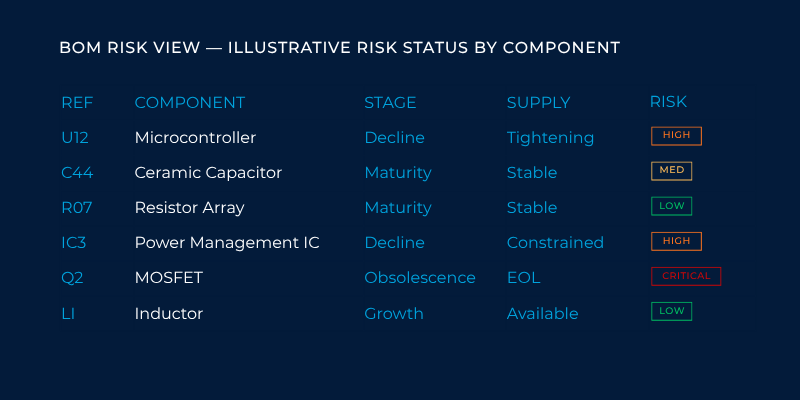
BOM management is often treated as documentation. In reality, it defines how risk is distributed across a product.
Every component in a BOM introduces exposure that extends beyond the part itself.
Lifecycle exposure
Every component has a trajectory toward obsolescence.
Supply dependencies
Concentration in suppliers and regions creates hidden fragility.
Compliance requirements
Regulatory obligations that change across markets and time.
A BOM doesn’t just describe what a product is made of. It determines how resilient that product is to disruption.
BOM REALITY
Most BOMs are static snapshots.
But lifecycle, supply, and compliance risks are constantly changing.
What looks stable today may already be at risk tomorrow.
Why BOM Management Fails
Most BOM management systems show what exists—but not what is changing.
Static
A fixed snapshot that doesn’t reflect real-time market or lifecycle changes.
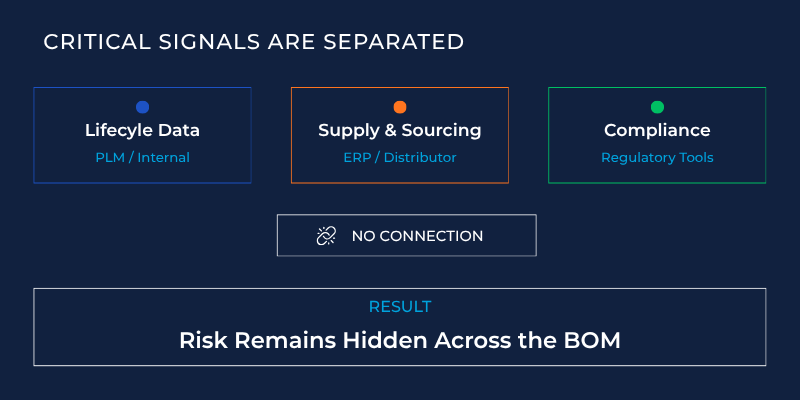
Disconnected
Lifecycle, sourcing, and compliance data live in separate systems with no shared view.
Reactive
Teams respond to risk after it surfaces rather than monitoring for it continuously.
As a result, teams often:
Discover risk too late
React to shortages instead of anticipating them
Struggle to see exposure across the full BOM
Improve BOM management with real-time lifecycle, supply, and compliance visibility