Supply Chain
How to Reduce Supply Chain
Risk
in Electronics
Disruption is rarely random. It is the result of concentrated dependencies.
DEFINITION
What is supply chain risk in electronics?
Supply chain risk in electronics is the potential for production disruption caused by component shortages, supplier instability, lifecycle changes, geographic concentration, and limited sourcing visibility.
40 to 50 Weeks
Lead times for critical electronic components during constrained periods. This is more than a purchasing issue—it is an early warning signal.
The Real Structure
Electronics supply chains are often described as complex. In reality, they are concentrated.
Supply Chain Reality
Hidden exposure—often unnoticed until it's too late.
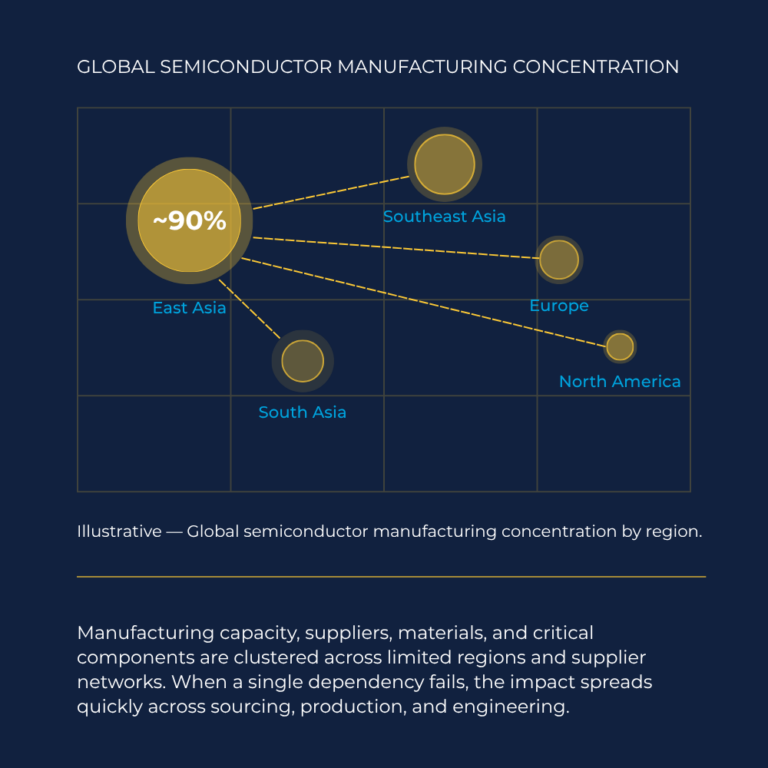
Semiconductor production is highly concentrated. A disruption in one region can affect global component availability. For manufacturers, this creates hidden exposure.
Often unnoticed until:
Lead times extend
From weeks to months, with little warning in the distribution channel.
Approved sources narrow
Preferred suppliers deprioritize older parts as demand shifts.
Alternates become difficult to qualify
By the time you search, the best options are already constrained.
Lead Time Signal
40–50 week lead times are an early warning signal.
Not a purchasing inconvenience—a structural indicator that something upstream has already shifted.
It signals that:
- Supplier capacity is shifting
- Demand is outpacing supply
- Availability is tightening
Identify vulnerable components before they disrupt production
The Nature of Risk
Disruption emerges from the interaction of multiple factors.
When these factors align, sourcing becomes unpredictable and production plans become harder to protect.
Lifecycle Constraints
Parts entering decline while still embedded in active designs.
Geographic Concentration
Manufacturing capacity clustered in limited regions.
Supplier decisions
Capacity reallocations driven by demand for newer technologies.
Demand volatility
Sudden demand surges consuming available inventory globally.
Limited alternates
Few qualified substitutes identified before shortages emerge.
Single-source dependencies
Critical components with only one approved supplier.
Why Visibility Is Limited
Most organizations operate with fragmented data.
- Lifecycle data in one system
- Sourcing data in another
- Compliance tracked separately
- Supplier knowledge distributed across teams
- BOM data disconnected from market signals
Without integration, teams see only part of the problem.
A component may appear available at the part level while introducing risk at the:
BOM level
Multiple affected parts across a design may not be visible individually.
Supplier level
A single supplier serving multiple components concentrates exposure.
Program level
Risk that spans product lines creates compounded scheduling pressure.
What Reducing Risk Requires
The goal is not just to respond faster.
It is to identify risk early enough to avoid disruption entirely.
That includes the ability to:
- Identify exposure across components
- Understand supplier dependencies
- Track lifecycle changes
- Monitor availability trends
- Find alternates before shortages occur
- Evaluate risk at the BOM level
Risk Assessment for Electronics Components
A component risk assessment answers whether a part is stable, vulnerable, or a future sourcing challenge.
This provides engineering, procurement, and supply chain teams with a shared, data-driven view of risk—and a clear path to action.
- Stable
- Vulnerable
- Lifecycle stage
An effective assessment considers:
- Lifecycle stage
- Supplier health
- Authorized availability
- Lead time trends
- Geographic concentration
- Alternate part options
- Compliance status
- BOM-level impact
Component alternatives
Find Component Alternatives
Locate reliable alternative parts that maintain supply continuity and compliance across your design.
Obsolescence intelligence
Prevent Obsolescence
Identify form-fit function replacement early with visibility into lifecycle and supply risk.
Lifecycle intelligence
Track Lifecycle Exposure
Understand where every component sits in its lifecycle-and what comes next.
GET STARTED
Find component, supplier, and lifecycle risk—before it impacts production
Get visibility into component availability, supplier health, and lifecycle exposure across your BOM.