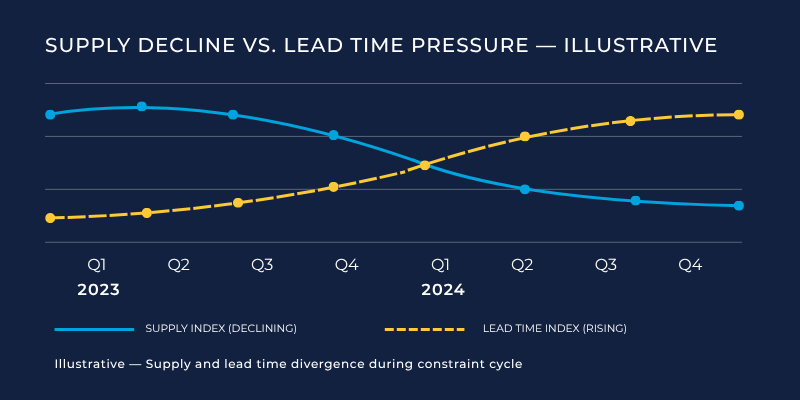
Component shortages occur when demand exceeds supply due to manufacturing capacity shifts, component lifecycle decline, technology transitions, and supply chain disruptions.
The Structural Shift
Component shortages are often described as cyclical. Increasingly, they are structural.
They reflect long-term shifts in how components are produced and consumed — not short-term volatility that resolves on its own.
Manufacturing capacity allocation
Technology transitions
Sustained global demand
What appears to be a short-term constraint is often a deeper misalignment between how components are produced and how they are consumed.
Market Shift
Shortages are no longer driven primarily by temporary disruption.
Products often outlive the components they rely on. Without lifecycle alignment, risk compounds across the BOM, the supply chain, and the product lifecycle itself.
Persistent demand in key sectors
Automotive, industrial, and defense demand sustains pressure on legacy components.
Supplier prioritization toward newer technologies
Fabs allocate capacity to higher-margin, higher-volume newer nodes.
Capacity consolidation across fewer manufacturers
Market concentration means fewer fallback options when a supplier shifts.
The Pattern
A component shortage typically emerges from a predictable sequence.
The result is sustained constraint—not short-term volatility that resolves with time.
Supply shifts toward newer technologies
Manufacturers reallocate capacity to higher-demand, higher-margin product generations.
Demand for legacy components continues
Long product cycles in industrial, medical, and defense keep older parts in active use.
Viable alternatives are limited or unavailable
Without pre-qualified substitutes, teams face the shortage with no fallback.
Why Teams Struggle
Component shortages are difficult to manage because they are detected too late.
Detected too late
Lead time changes and availability gaps appear after supply has already shifted.
Poorly understood at the system level
A single part shortage can cascade across the BOM in ways that aren’t immediately visible.
Managed reactively instead of proactively
Without early signals, teams respond to shortages instead of preventing them.
By the time shortages become visible, teams are left with:
Limited sourcing options
Higher costs
Increased redesign pressure
Key Insight
Shortages are not the problem—they are the signal.
The real issue is whether teams can act before constraints escalate.
Manage component shortages before constraints impact production